Sunday, September 4, 2016

POTUS @ Midway

If the title of this post leaves you a little confused, don’t worry, I didn’t know what POTUS meant until a week or so ago. Before I left the atoll in late July rumors of a possible visit by the President of the United States (acronym = POTUS) were pretty thick among the residents of Midway, triggered perhaps by a group of 30 or so White House staff and interns under somewhat mysterious circumstances the week before.  At least I think they were staff and interns, no one really seemed to know who exactly they were and all they did for their day here was walk around, eat, and go out on to the reef to snorkel.

But shortly after I returned to the atoll in late August, it became official: POTUS was planning a visit on his way from the World Conservation Congress in Honolulu, where he would announce the expansion of the Papahānaumokuākea Marine National Monument, to an economic summit in China. In fact, flying with me on the plane were some key staff of the Fish and Wildlife Service who would be representing the agency during the White House visit and leading preparations.  This would be only the second time POTUS visited Midway, the first being Richard Nixon when he held a secret meeting here President Nguyen Van Thieu of South Vietnam.  Evidence that preparations had already begun were everywhere upon my re-entry. Not a single albatross carcass did I see on my first day back and the musty smell of dead birds had been supplanted with the fragrant aroma of flowering trees. New park benches sat alongside the roads as Chugach staff, redeployed from their normal duties, were busy cleaning nearly everything that could possibly be cleaned and grooming the normally disheveled vegetation. The island’s only pub, Captain Brooks Tavern, was renovated in anticipation of a swarm of thirsty visitors.

A week of intense preparation preceded President Obama's visit to Midway. Clockwise from upper left: Chugach staff mow the "lawn" at the historic Midway House; Yuki Takahashi helps hang new materials in the Visitors Center; Ann Humphrey works on the landscaping at the Midway Harbor Memorial; Savanna Jade and Nai Degracia take a short break after working on new visitor displays.

Within a couple of days more personnel from a variety of agencies and equipment started arriving.  [Redacted] teams, [Redacted][Redacted], and a [Redacted] occupied the officer’s quarters that formerly housed our volunteers. The Midway House, which was in the midst of a substantial renovation, was readied for visiting White House Staff. The population on the island doubled during the week prior to the POTUS visit and was expected continue swelling up until September 1st, the day of the expected visit, when 150 people or so people would occupy this little island. Large cargo aircraft, C-17s, landed at the normally sleepy Henderson Field regularly carrying both people and supplies. Meal hours at the Clipper House were extended to accommodate the extra visitors and Chef Pong and his crew worked long hours to meet the demands.

With exception of the refuge manager, the roles that I and the Fish and Wildlife Service staff and volunteers that I work with were to play on the big day were vague and uncertain, although we all hoped that we’d have at least some contact with the POTUS. What was clear was that we would be asked to help out with the preparations in a big way and each day we met with the organizers to get the latest news on how many planes might be arriving that day and what things we could do to help. We were tasked with a variety of menial duties which included everything from landscaping to cleaning to creating signs for educating visitors on proper wildlife etiquette. After a day of shoveling sand and rearranging large paving stones at the Midway Harbor Memorial with co-worker Ann Humphrey, I worried that I had done some damage to my lower back. The tone of the island had changed from being relaxed and lighthearted to somewhat tense and very serious. Maybe it was learning that everyone was being investigated by the Secret Service and that our phones might be tapped? Or having our usual Friday afternoon social in the community garden shut down? Or perhaps it was announcement of the curfew? It probably didn’t help that during the three days preceding the visit, Midway was hit by a series of sky-darkening storms producing torrential rainfall and flooding roads and low-lying areas. Word spread that if Hurricane Madeline took a turn towards Honolulu or if storms continued to batter Midway, the POTUS visit might even be cancelled. What humor there was on the island was mostly of the dark variety. While helping to hang new posters in the Visitors Center, I stretched to hold the two ends of a poster as high as I could against the wall, a posture which prompted a flashback to the fall of 2015 when I was being frisked by Border Patrol agents during a difficult crossing back into the states from Mexico.

Severe storms flooded the islands in the days before the President's visit.
The day before the big event, during an “all island meeting” it was confirmed that everyone on island, including the incredibly hardworking Thai guys that keep this place running, would have the chance to greet the POTUS as he stepped off of Air Force One to begin his tour.  Exciting news for sure, although we also learned that preliminary plans to involve the volunteers in the president’s tour (feeding white terns and planting a native shrub) had been nixed after White House review. Not being a “big wig” and not an employee of the US Fish and Wildlife Service (I work for the partner group National Wildlife Refuge Association), I don’t know what I'd expected but I will admit to being a little surprised and disappointed when I learned that, once the meet and greet was over, I would have to return to my house and stay there the whole day until Air Force One departed (something akin to "house arrest"). Why does my president need to be protected from me? Hell, I even voted for the guy (twice) and helped clean up the island so he’d have a pleasant visit!  I briefly considered not even going to the meet and greet as a sort of protest.

A National Geographic Team, which included marine conservationist Sylvia Earl, were invited by the White House to be part of the event. Earl announced to Obama that a deep ocean fish would be named after him.

The night before the big day the storms began to clear and I went out with oceanographer and marine conservationist Sylvia Earl and a couple of National Geographic photographers to get some footage of Bonin Petrels at what turned out to be one of the most amazing sunsets I’ve witnessed here. Clearly, things were looking up for the POTUS’ visit and by next morning skies were blue again and the island looked and smelled about as fresh as it probably has since Captain Brooks landed his ship here over a hundred years ago. All of the islands residents gathered shortly before Air Force One was scheduled to arrive. Seeing the excitement of my co-workers – and especially the Thai guys – during these moments made me realize how stupid I would have been to boycott this event.

Storms exited the area the evening before the big day producing an extraordinary sunset. 
Anticipation continued to build as we were led to the greeting area, a small patch of pavement enclosed by sawhorses and dozens of photos were taken before Air Force One even began its decent to Henderson Field.  When the plane finally landed, a few dozen members of the press exited the rear door and took up strategic positions. After not too much delay the front door opened, a staircase was extended and, after a half dozen or so guards of some sort walked off, down came Barack Obama, looking casual, relaxed, and decidedly cool. No need to wear a suit at Midway, some high level wonk had clearly decided! Within moments he was shaking hands and greeting folks. He even made it a point to ask people their names, something that seemed pretty down to earth for the POTUS, and then graciously posed for a photo with all of us. And then he was off in a motorcade of golf carts flanked by black SUVs (he was in a golf cart) to begin his tour which included a stop at the Midway Harbor Memorial, the Cargo Pier, Turtle Beach, and then a trip by boat to go snorkeling at the reef. I went home to read, sew, clean the house and drink beer. On the way I walked alongside Kidjarom Wongwei, one of the cooks at the Clipper House, and he was so incredibly jazzed by the event (he also met First Lady Laura Bush when she visited here in 2007) that whatever residual bad feelings that I may have still had vanished.

Arrival at Midway. From top to bottom: Air Force One just after landing; Obama heads to meet the crowd; POTUS heads off to tour the island in a golf course motorcade.

By all accounts the trip was a success.  Fish and Wildlife staff felt like they got a positive message across, the White House was rewarded by positive depictions of the president in the media, and Chugach succeeded in having run what could be considered a “preparation marathon” in record time. When the POTUS departed, the mood on the island immediately relaxed and folks began taking down all the things that went up.  Last night Chugach generously hosted an “appreciation party” for the residents and the few remaining visitors and it was a real celebration as guys I’d never seen there before joined in singing Thai songs and dancing to the karaoke machine. Today, the last C17 took off and with it the last of the crew stationed here for the visit and things are finally back to normal.  Midway normal that is!

President Obama with US Fish and Wildlife staff and the residents of Midway (Official White House Photo by Pete Souza)


Links to a few news stories about POTUS’ visit:


Monday, August 29, 2016

Papahānaumokuākea

A few days ago President Barak Obama did something pretty extraordinary when he signed Presidential Proclamation 8112 expanding the area encompassed within the Papahānaumokuākea Marine National Monument to 582,578 square miles (that’s twice the size of Texas), making it the largest conservation area on earth. Everyone loves a good superlative and having worked for in the field of conservation for a few years I’ve heard my share, some more contrived than others. But this is one is so hard to comprehend it bears repeating: THE LARGEST CONSERVATION AREA ON EARTH.


Before my conservative friends click “close” let me relate a couple of important facts about the pre-Obama history of this thing. Back in the days when wearing bird feathers on one’s hat was a sign of status and the harvest of wild eggs for food was commonplace, ships plied remote corners of the Pacific Ocean looking for seabird colonies to exploit. Reports of large numbers of seabirds being slaughtered in the Northwestern Hawaiian Islands prompted President Teddy Roosevelt to establish the first protections for wildlife there in 1909. Incremental steps were made in subsequent years but it wasn’t until 2006 that significant progress was made when President George W Bush signed Presidential Proclamation 8031 establishing the Monument  although at the time it had a somewhat more bureaucratic name at the time.

In these times when those who might be labelled “red” or “blue” rarely have much in common, what is it about this place, the Northwestern Hawaiian Islands, that creates such consensus regarding its importance for conservation? I think it boils down to three things. First, this is a remote area of the globe that, aside from a fairly limited commercial fishery, has little economic importance. In a world where habitat for seabirds, marine mammals, turtles, and coral reefs has experienced sharp declines, these uninhabited islands provide critical habitat and are the last strongholds for two species of albatross (Laysan and Black-footed), Hawaiian monk seals, and green sea-turtle). Moreover, recent scientific explorations have revealed that the area harbors an extraordinary diversity of marine species – over 7,000 of which about one-quarter are found nowhere else on earth – which include the longest living coral species in the world, black coral, which inhabits the deep waters of this region and provides habitat for various fishes. But of course, the significance of this area has long been known to the native people of Hawaii who have long considered these islands and the seas that surround them the source of all life and which is reflected in the name given to the monument: Papahānaumokuākea.


Finally, if you have had your head in the sand (or some other dark place) you may have missed the fact that our earth is changing and that low-lying islands and the seas that surround them are especially vulnerable to some of these changes which include  not only warming but, perhaps more importantly, acidification and other impacts. In expanding the area protected by the Papahānaumokuākea Marine National Monument, President Obama has taken an important step towards ensuring that this area will be able to adapt to these changes and, hopefully, retain the biological riches that have evolved here over the past 100 million or so years. Of course this will not be enough as the ocean is fluid and the new boundary, however large, is rigid.  When the President visits Midway this week, I am hoping that it will inspire him to undertake even greater steps towards protecting our oceans.  We’ll see I guess!

If you have any doubt as to the extraordinary significance of this area, take a look at this video which provides some fantastic footage from a scientific exploration made in 2016 by the NOAA research vessel Deep Discover within what is now part of the marine national monument.  Enjoy!


Monday, July 18, 2016

Go By Bike!

When I was weighing the pros and cons of taking on this job there were lots of factors to consider but one of the real attractions was that I’d be living on an island where bicycles were the primary mode of transportation. What I wasn’t aware of was the reasoning behind it. Sand Island – the largest of Midway’s three islands and the only one where people live – is certainly small enough (about 2 ½ miles long and half a mile wide) that one might argue that automobiles just aren’t necessary. But there are lots of places even less expansive where cars rule the roads. Here, it turns out that the sheer number of ground-nesting birds is what makes bicycles and other more nimble modes of transportation more practical. Even if one had a car, it would take forever to get anywhere as during the nesting season it would need to stop every few feet to move birds out of harm’s way.

Use of bicycles on Midway dates back at least to the early days when the island was a Naval base, I wasn’t able to find any references to their use during the very early days of settlement (records indicate though that in 1904, a certain Dr. Martin Crook, who’s mobility was hampered by having one wooden leg, had two donkeys shipped in to help him get around the island). 


Bikes have been a popular way to get around on Midway since the "Navy Days" (photo courtesy Roy Warren).

The only “good pavement” on Midway is the main runway of Henderson Field which is kept immaculately paved according to strict Federal Aviation Administration standards. All the other roads and paths on Midway are much more rustic but serve their purpose well, getting people from their homes to workplaces to the Clipper House and to the (few) recreational facilities that the island provides. From my house it takes less than five minutes to get to the office, the Clipper House, the Ship’s Store, or the beach.  More extensive touring can also be had by circumnavigating the island, a total distance of just under 9 miles. I like to do this on Sunday mornings and it’s a great way to re-acquaint myself with parts of the island I don’t typically visit from day to day. Nearly all the bikes on the island are single-speed "cruiser types" with old school "coaster brakes" which took a while to get used to. Visitors are strongly encouraged to rent bikes while long-term residents, such as myself, are given one to use for the length of their stay.


At just around two square miles in area and with a fairly extensive network of narrow roads, Sand Island is easy to explore by bike. Crossing the runway is the only tricky part as the airport must be contacted.

It would be misleading to suggest that bicycles are the only way folks get around out here as golf carts and four wheel UTVs (“utility task vehicles”) are also commonly utilized, most often for work purposes that require the hauling of cargo or tools. A golf cart “limousine” that seats eight is used to ferry passengers back and forth from the airport to “town”. Several very small motorcycle/scooter things are also used by some of the Thai workers. I’ve asked where they came from and how it is just a couple of guys have them but have never gotten a straight answer. In addition there are a couple of trucks and some heavy equipment on the island that you see once in a while. It is quite a spectacle to move a front end loader on one of the small roads as it must go very slowly while an escort vehicle moves ahead to clear its path. The most impressive (and most expensive) vehicle on the island is a super fancy fire truck that is dedicated for airport use and probably worthy of its own blog post someday!


When a bicycle isn't practical, golf carts are commonly used for transportation. Clockwise from upper left: "Congestion" at the community garden; golf carts are "albatross friendly"; it's important, however, to check under the cart before driving off as albatross chicks often crawl under them for shade; the "limo" takes a group of passengers to the airport.
The lack of motor vehicles at Midway definitely adds to the peaceful and quiet nature of the place. It also makes you realize how much space automobiles require both in terms of roads, garages, and parking spaces. Lacking the need for extensive paved areas, our little community here on Midway  has a whole different character, the narrow lanes and footpaths lending it a much more intimate feeling. Getting around by bike also puts you into contact with your neighbors on a regular basis and makes it easy to stop and have a quick conversation. And , of course, getting around by bike is a great way to get exercise as part of your daily routine.


Bicycles are a great way to get around on Midway and are the primary mode of transport. Clockwise from upper left: the biology crew cycling from one restoration site to the next; a Sunday morning circumnavigation of the island; Refuge manager Bob Peyton (right) stops for a quick chat with Eric Moore who heads up the Chugach operations; bike valet service is provided by a Laysan albatross chick at Charlie Hotel.
I’m pretty sure I couldn’t live on Midway forever as the isolation of this faraway place would almost certainly prove too much. But my experience here has me thinking that I would definitely consider sacrificing some of the conveniences that car-centric communities provide if I could live in a place where, like here, people and wildlife take priority over roads and automobiles.

Monday, July 4, 2016

Independence Day

I really did not want to write two consecutive posts about albatrosses, but the situation just plain demands it. Let me explain. As I discussed in my previous post, the process of raising a young albatross is very time-consuming and complicated and demands incredible endurance on the part of its parents. I didn't say too much though about how arduous the process is from the point of view of the young chick but given what’s going on around here on Midway right now, I feel compelled to share some of my thoughts and observations about it.

As is the case for all birds, the life of a chick begins while it’s in the egg.  For a Laysan albatross, this lasts about two months while parents take turns incubating it. After spending a couple of days pecking its way through the shell, the newborn hatchling is wide-eyed but small (less than half a pound) and very vulnerable and is thus brooded and guarded by its parents who ensure that a frigatebird or other avian predator doesn’t fly off with it in its beak. Next is a prolonged period of rapid growth with occasional feedings by the parents who travel far into the ocean to procure food for the ravenous chick. This goes on for about five months until the chick is ready to move on to its next stage of life for which it must learn to how fly and forage on its own, completely independent of  its parents. As Laysan albatross begin nesting around the first of the year, early July is an especially important and exciting time and Independence Day (the rarely invoked but official name of the Fourth of July holiday) takes on real significance.

When I arrived on Midway back in mid-April, the chicks were about two months old, downy and plump. Over time, I began to see signs that some were growing adult feathers, usually just a stripe of white visible on the wing from deep below the down. Eventually smooth wing feathers began to develop and the down gradually began to disappear. I remember one day a few weeks back riding my bike to work and doing a double take after I saw a chick wearing a suit of feathers that looked almost exactly like that of an adult.  

Various stages in the life of a Laysan albatross chick (clockwise from upper left): Downy chick; Chick showing some adult feathers on wing, Nearly complete molt with only "wig" remaining; Complete suit of adult feathers.

Then something really startling happened. Chicks began flapping their wings!  Rainstorms seemed to really stimulate this behavior, perhaps because it helped them keep their feathers dry. It wasn’t long before some of the older birds began catching air on days when the wind gusts provided them with sufficient lift (the design of an albatross’ wing makes it difficult for even adult birds to take off using just the power of their muscles). Once a young bird feels the thrill of flight, it figures out that it can accomplish even more with a running start. And so it’s been for the past month or so with birds making incremental progress day by day with some leaps and bounds on the windier days.

A young Laysan albatross catches some air during a squall on Sand Island, Midway Atoll. 

In the past week though, something even more remarkable has been taking place. Some young birds are feeling confident (or desperate) enough to leave their nest sites and making their way towards the shore. This is a sure sign that their parents are no longer delivering food for them as parents recognize their young not by who they are but by where they are and once a chick wanders more than a dozen feet from its original nest location, adults can't find them. Many chicks seem curious about the water and venture out to swim. Some have been seen making short flights across the open ocean but many more though have washed up dead on the beach or in the harbor.

Many Laysan and a few Black-footed albatross have left their nest sites and converged on Turtle Beach, Midway Atoll.

It’s a very tense time here on the atoll as young albatross strive to make it on their own. While it seems like just yesterday the island was busy with dancing young “single” albatross and parents were frequently seen coming and going to feed their offspring, now the chicks outnumber adults about fifty to one, and it is rare to see a chick being fed. When an adult does show up there’s usually a period of five minutes or more of confusion as it is surrounded by hungry peeping chicks and it must figure out which mouth among the many is its actual offspring. Some chicks still look so downy and small that it’s hard to imagine it will be able to make it and one broiler of a day could put a lot of them over the thermodynamic edge.

The tension rubs off on me too and I find myself feeling anxious about the fate of all of these birds and can’t help but feel some despair when I find yet another one dead on the road, on the beach, or in my backyard. The best way I've found to keep it from getting me down is to simply try to keep my focus on the birds that seem to be doing well and encouraging them on in my own way. (I also have been known to try to rescue drowning albatross and have a bite mark on my left arm as a result!).

One fledgling Laysan albatross takes a short flight while another dries its wings in the inner harbor of Sand Island, Midway Atoll.

It's been an intense and interesting weekend and I've spent a lot of it watching the albatross and thinking about the amazing lives they lead and how for many animals the chances of making it from newborn to independent adulthood are pretty slim. In a weird way it's made me appreciate my own life even more and made this Independence Day an especially meaningful one.

Thursday, June 16, 2016

Not Very Gooney at All Actually

An appreciation for the Laysan Albatross

The indigenous people of Hawaii call this bird “Moli”. To scientists it’s Phoebastria immutabilis. But at some point in recent history someone called an albatross a “gooney bird” and the name has stuck. It’s not a very kind name, implying foolish, silly, or awkwardNames matter (just ask anyone belonging to what might be considered a “minority group”) and over time I think the reputation of the Laysan Albatross has suffered as people – English speakers at least – have tended to focus on its less elegant aspects while downplaying the truly astonishing characteristics that define this magnificent seabird species. Here I hope is to disabuse you of the notion that these birds are “gooney” at all and tell you why I think they deserve your respect if not awe.

Laysan Albatross are often called "Gooneybirds" and characterized as being silly or clumsy.

Laysan albatross is one of 21 species of albatrosses and range across a wide swath of the Pacific Ocean from Japan to Mexico. Despite this large range they nest on just a few isolated islands. Here on Midway Atoll, the bird is extremely abundant with about 450,000 breeding pairs documented at last count, comprising approximately 75% of the global population.


Laysan albatross nest on just a few remote islands but forage across a very wide swath of the Pacific Ocean extending from Japan to California and from the equator to the Aleutian Islands.

Albatrosses have been around for millions of years and have evolved to do one thing extremely well, to survive by harvesting resources that are spread across thousands of miles of open ocean.  Like all birds though, reproduction requires dry land. And in the case of albatrosses they require places without mammalian or reptilian predators because they nest on the ground and their chicks are very tasty (we know this from the records of early sea voyages) and extremely vulnerable to hungry mouths. Well it turns out that land free of predators is a pretty scarce commodity. Every continent as well as the islands that lie offshore team with primates (us included), dogs, cats, weasels, snakes, and the like. So albatrosses have had to resort to raising their young on remote islands where no land predator has ever made landfall. For Laysan Albatross these have included the Hawaiian islands, and a few islands off the coast of Mexico and Japan. One the Polynesians settled the main Hawaiian islands, the albatrosses were dispatched quickly.

It turns out though, by accident of geologic history, that the only suitable islands for nesting happened to be located in parts of the ocean that weren’t especially rich when it comes to food. So during the breeding season (which lasts for months) the Laysan Albatross must travel far to find the squid, fish eggs, crustaceans, and carrion it needs to survive. To manage this it evolved extraordinary flying abilities. Albatrosses, have very long wings that "lock" into place and utilize a technique called Dynamic Soaring which exploits wind gradients and allows them to fly great distances using very little energy. An albatross can spend months on end in nearly continuous flight as it pursues food over many thousands of miles of open ocean.

Masters of the air!  A typical Laysan Albatross flies over a million miles during its lifetime utilizing a technique called "dynamic soaring".
These abilities come at some cost to the bird when it comes time to land.  It's not uncommon for an albatross to land hard, sometimes even flipping over, if the winds shift suddenly during its approach. Takeoffs can be tricky too as an albatross cannot generate much lift by simply flapping its wings and has to get a running start into the wind to resume flight.  But before you start laughing at a Laysan albatross after suffers a crash landing, think about the fact that the bird may have just returned from several weeks or months at sea surviving gale force winds, rain, and snow.

Laysan Albatross are very long-lived birds that spend up to their first 9 years learning how to make their way in the world before settling on a mate and attempting to raise its first chick. They are monogamous and put a great deal of effort into finding the “right one” which entails a fairly elaborate courtship ritual involving of dancing, bill clapping, braying, screaming and other interesting behaviors. People watching young albatross in the heat of passion often find it “gooney” but ask yourself this: if an alien being were to evaluate you solely on your behavior in the bedroom, how do you think you'd come across?

Laysan Albatross engage in extensive courtship rituals and mate for life.

Once a Laysan Albatross finds the love of its life the pair takes on the monumental task of raising a chick. After the egg is laid both female and male share the task of incubation which lasts about two months. A parent may sit on the nest for two weeks straight waiting for relief from its mate all the while not eating or drinking. After hatching comes the daunting task of feeding the ravenous chick. Again the responsibility is shared by both parents and each undertakes epic journeys far into the ocean to gather enough food to provision the fast growing nestling. A study of Laysan Albatross using global positioning systems and satellite transmitters discovered that one female albatross spent 29 days at sea travelling over 7,500 miles on a single foraging excursion. And they don’t do this once but many times across their long lives. The longest living wild bird known is a 65 year old Laysan Albatross female living on Midway Atoll. This year "Wisdom" as she has been named, nested perhaps for the 30th time (albatrosses lay just one egg and typically do not breed every year) and is currently raising a healthy chick. Imagine the hundreds of thousands of miles that she has traveled and the things she has seen across the decades. The dedication that albatrosses show for their families is impressive and inspiring. The word “gooney” just doesn’t seem a good fit.

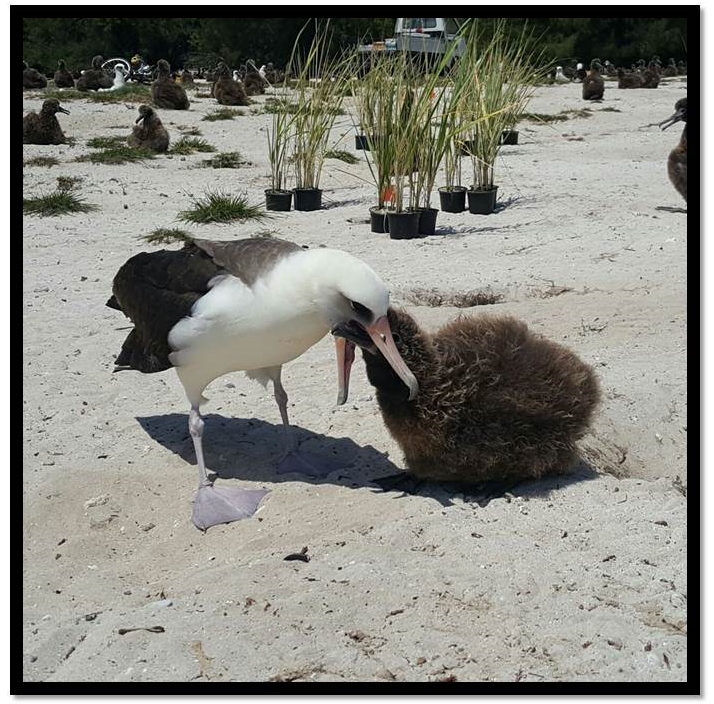
Dedicated parents. Both male and female Laysan Albatross travel tens of thousands of miles to find food for their offspring. Partially digested food and oils are regurgitated into the chicks bill.

In all fairness, I think that most people who call albatrosses “gooneybirds” do so with no disrespect. In fact, when I arrived here on Midway I used the term a few times thinking it kind of cute. But I also believe it's possible that this epithet has at times made it easier for people to do things that caused serious harm to Laysan Albatrosses. While describing the myriad ways that albatrosses have suffered at the hands of humans is a topic too large to tackle here (look forward to that in a later post) suffice it to say that when Midway and other Northwestern Hawaiian Islands were being developed for military use, albatrosses were inconvenient and many were killed to make way for the roads, building, and aviation facilities that were constructed. Maybe by calling them “gooneybirds” it was a little easier to ignore the suffering we caused them.

Maybe now though it’s time for a more honest reckoning. If, indeed, Laysan Albatross are “gooney” at all it’s only when they are on land. And since research shows they spend about 95% of their lives at sea where they are magnificent, graceful creatures then that would mean they are “gooney” at most about 5% of the time. Not very gooney at all actually!

Sunday, June 5, 2016

Food and Beverage

The challenge of staying well-nourished on a desert island

There is a good reason why Midway Atoll was never settled by the Polynesian inhabitants of the main Hawaiian Islands. The three small islands together make up just a little over 2 square miles in land area, have no freshwater lakes or rivers, are mantled with fine white coral sand not well suited for agriculture, and are over 1,000 miles from the main Hawaiian Islands (the closest place that could be considered “civilization”).  The first people to attempt to inhabit the atoll, employees of the Pacific Commercial Cable Company, were provisioned by ship and dug wells to provide fresh water (interestingly, small coral atolls though lacking in fresh surface water often contain a thin sub-surface “lens” of freshwater that resulting from it having a lower density than seawater).  It turned out though that food delivery by ship was pretty unreliable. During those times Midway lacked a harbor or pier and the coral reefs that surround the islands made landings difficult, especially during inclement weather. Supply ships frequently turned back before making their deliveries or, worse, wrecked, leaving the island's residents hungry and frustrated. It didn’t take long for the Cable Company employees to take matters into their own hands and soon they were importing soil, plants, and livestock to grow food on their own and reduce their dependence on the outside world for their provisions.

Despite all of the development that has occurred at Midway since that time, keeping the current residents – 50 or so folks at any given time – hydrated and nourished is still a major challenge. The small wells that provided freshwater to early inhabitants could not satisfy the demand once the island’s population swelled to several thousand during World War II; during these times efforts were made to capture rainfall (Midway receives approximately 43 inches a year) and store it in cisterns. Today, the large runway of Henderson Field  (approximately 7,800 feet long and 150 feet wide) on Sand Island is used for this purpose.  Rainwater falling on the runway flows into grates and is then pumped into three, 4 million gallon water tanks.

Three large tanks allow for storage of 12 million gallons of water on Sand Island, Midway Atoll (Laysan ducks in the foreground enjoy puddles created by a rainstorm).

From there some of the water is sent to an elevated water tank to for irrigation, fire hydrants, and other uses which do not require the water to be purified. The remainder goes to Sand Island’s water treatment plant which uses chemical sterilizers (something akin to chlorine) to purify the water for domestic use. Though the water coming out of the taps in houses and offices is potable, many people (including me), prefer some additional purification before drinking.  A small water and ice house next to Charlie Barracks is open 24/7 providing double filtered water and ice cubes  a fabulous amenity!

What about food?  Similar to residents over a hundred years ago, the folks living here rely almost entirely on food brought in from the outside world but fortunately the deliveries are now much more reliable. Food is transported to Midway by both ship and aircraft.  Every six months the privately operated 185 ft supply vessel M/V Kahana, delivers a load of food, fuel, and other supplies to the atoll.  This is how sacks of rice, canned food, cases of soda pop, and other heavy, non-perishable items make it out here. Quantities of frozen foods are also delivered in a refrigerated container. Supplementing this are deliveries made via air. Every two weeks or so, a small chartered jet makes the round trip from Honolulu to Midway carrying with it 12 passengers along with mail and various cargo which includes various fresh foods including fruits and vegetables. The couple of days following a flight are always exciting for this reason, as suddenly fresh blueberries appear replacing the previous week’s regimen of canned fruit.

As in times past, today’s Midway residents find it worth their while to raise some of their own food locally. A large greenhouse stands just to the east of the Chugach building. Inside is a modern hydroponic garden where Sumeth “Hin” Camseecha raises a wide variety of vegetables, including lettuce, cucumbers, tomatoes, and Thai chiles. There is also an outdoor Community Garden which serves multiple purposes. Anyone wishing to grow their favorite foodcrop can plant it here (as long as it’s not an invasive species) but this is also an important gathering place. This is the source of some key ingredients used in Thai cooking on the island including kaffir lime and lemongrass. On Friday afternoons I always try to stop for a beer when  Adoon Sripitak, the unofficial master of the garden, hosts weekly get-togethers which are attended by a diversity of island residents.

Residents of Midway Atoll are lucky to have local, fresh produce to supplement their diet. Top: A bountiful crop of greens being grown in the hydroponic greenhouse; Bottom: Friday afternoon at the Community Garden. 

So now you know where the food comes from but how does it get transformed from raw ingredient to the plate? The Clipper House is the island’s only and best restaurant. Open seven days a week for breakfast, lunch, and dinner, Pongsakorn “Pong” Wichaisawatdi and his three assistants cook up a tasty variety of foods appealing to both American and Thai palletes. It is hard to imagine Midway without the Clipper House as it is truly the social hub of the island as pretty much everybody takes at least some of their meals here. It is truly the only game in town but I find the eclectic mix of Thai, “American”, Italian, and other cuisines to be extremely appealing and my appreciation for Thai food continues to grow (I am still, however, very partial to the coconut curry dishes with Chicken Coconut Curry still occupying the number one spot). Mixing is not uncommon and the other day I saw someone eating a Chicago Style Hotdog with Pad Thai tossed on top as a finishing touch.

The Clipper House Restaurant at Midway Atoll where head chef Pongsakorn “Pong” Wichaisawatdi serves a variety of dishes to suit the tastes of patrons from both the United States and Thailand. An outside patio with a fine view of the lagoon is popular with US Fish and Wildlife Service staff and volunteers.
The only other source for food on the island is the Ship’s Store which has snack foods, some frozen foods and most crucially a selection of beer, wine, and liquor.  Unfortunately, the beer selection has not kept up with the times and only American Pilseners (read Bud, Coors) and two brands of Thai beer are offered (Chang and Singha). A co-worker asked me the other day if I'd noticed the cabinet with the sign saying "fine wines". No I hadn't, I replied.  "It's empty" she explained with some disappointment.  Those with more eclectic tastes must rely on care packages from home (Oregon IPA please!). These days with the ease of ordering food via mail, some islanders also supplement their diet through Amazon.com or other outlets. It is also possible to special order certain fresh, refrigerated, and frozen foods through the Ship’s Store and I have taken advantage of this getting fresh fruit and plain Greek yoghurt for breakfast.

While no one is ever going to starve on Midway, the limited availability of some foods still takes some adjusting. Also a consideration are the limited hours of the Clipper House which don’t always jibe with when I am hungry.  I have taken to making my own breakfasts (which includes real, whole-bean organic Arabica coffee mailed to me from Eugene, Oregon, rice cakes from Amazon.com, and fresh foods acquired from the Ship’s Store) and doing take out for dinner (5 pm is a little early for me). All in all though I certainly can’t complain.  Compared to the folks living here a hundred years ago, my food options are almost unimaginably varied and I have enjoyed the free time I have acquired since coming here that otherwise would be spent in the kitchen, not to mention the opportunity to sample some very fine Thai food. If anything, life on Midway could lead one to become "overnourished" making it even more important to stay active and get plenty of excercise. That'll be the topic of a future post!

Monday, May 30, 2016

Close Encounters

Why wildlife at Midway Atoll aren’t afraid of people and what that does to you

One of the great mysteries of modern biology is how it is that Charles Darwin knew so damn much. Not only did he correctly explain the mechanism by which the diversity of life on earth was created (i.e., the Theory of Evolution by Natural Selection) but as if this was not enough Darwin applied his genius to a variety of other subjects including the domestication of pigeons, earthworm biology, and the geology of islands. One of the first stops made by the HMS Beagle made on its voyage to explore South America was the Galapagos Islands where Darwin noticed something very strange about the wildlife there. They weren’t afraid of people. Darwin had an explanation for this, of course. On remote islands where mammalian predators were absent for thousands of years, there was no advantage for an animal to flee when approached by one. And if there was no advantage, maintaining that behavior would be a liability over evolutionary time. It all comes down to this: maintaining any unnecessary feature – anatomical or otherwise – constitutes a cost to an individual which over time results in lower fitness compared to an individual possessing only the things it needs to survive in its environment.

Had the Beagle sailed for the remote Northwestern Hawaiian Islands instead of the Galapagos, Darwin probably would have still come to the same conclusion. Like the Galapagos, these remote islands were never inhabited by people until very recent times and the native wildlife – predominantly birds – evolved with no predators. The lack of fear that the birds of Midway have for people explains why shipwrecked sailors in the 18th and 19th century and early feather hunters had such devastating effects on them. When approached the birds did not flee so anyone wishing to capture them for either the stewpot or the cargo hold could do so with little effort. Tens of thousands of birds were taken as a result and the populations of albatrosses, terns, shearwaters, and other species plummeted until regulations were affected by US President Teddy Roosevelt during the first decade of the twentieth century.

A Laysan Albatross hangs out on the sidewalk in front of the Midway Gymnasium.

As populations began to recover, people began finding reasons to inhabit these remote islands. The first were personnel hired by the Pacific Commercial Cable Company to build and operate a  telegraph station established on Sand Island of Midway Atoll in 1904. Employees – mostly from the mainland US – found themselves living among millions of seabirds that seemed to take little notice of them which certainly must have been perplexing. Despite decades of persecution, the birds still did not fear people. (Darwin would likely have an explanation for that too!) Laysan albatrosses, the most numerous birds on the island, built nests out in the open making little effort to conceal them, left their young unattended on the front porches of houses, and conducted their elaborate courtship rituals in close proximity to anyone who happened to pass by. Other species – terns, noddies, tropicbirds, etc. – behaved in similar fashion. Maybe, by living in such close proximity to such magnificent creatures, it was inevitable that these early residents of Midway developed a genuine respect and deep appreciation for their avian neighbors. Early records attest to this in various ways: from the decision to ban cats and dogs from the island to the formation of the Goofy Gooney’s Club which honored "the silent cooperation given them by the curious residents of the Midway atoll to the new strangers and the hazards they brought”.

It wasn't long before the Midway and other Northwestern Hawaiian Islands were recognized for their potential strategic military importance. But even as Midway was transformed from a sleepy telegraph station to a prominent Naval Air Facility, amicable relations between the seabirds and the human inhabitants persisted. This is not to say that there wasn't an impact on the birds; habitat was destroyed, antennas, seawalls, and other hazards to birds were erected, and many seabirds were undoubtedly killed through collisions with aircraft and other causes. Some species, such as the Laysan Rail, were not able to cope with the change and went extinct but most were able to adapt. Through it all, the people of Midway seemed to take a certain pride and interest in the birds. The official insignia of Midway – an image of two Laysan albatross “sky mooing” – eventually embellished everything from a the island newspaper to the movie theater.

Early residents of Midway identified strongly with their avian neighbors and recognized them in a variety of ways. A symbol representing courting Laysan Albatrosses adorned everything from the newspaper to the theatre on Sand Island.

Today, the folks living on Midway continue the tradition of tolerance and respect for their avian neighbors. People dodge albatrosses every day while travelling to and from work and pick up chicks off the road when necessary. When the sun sets, windows covered with curtains or blinds in religious fashion lest Bonin petrels, nocturnal seabirds attracted to light, fly into them. In the morning White Terns perch on the windowsill and stare at you through the window. Tropicbirds brood their chicks in the front yard in full view and emit a harsh bark only if you get so close as to risk stepping on them. Laysan’s ducks forage on the patio and parade their chicks through the yard. And people still pay homage.  The electrician’s golf cart has an image of an albatross painted on its side and at a recent evening of karaoke seabirds were displayed along with the lyrics to the songs.
Because the native fauna of Midway don't have any innate fear of people, close encounters with wildlife is common. Clockwise from upper left: A Laysan Duck outside forages outside my house; this newly hatched white tern stared at me intently while I took its portrait; Sooty Terns on Eastern Island lay their eggs directly on the ground in plain sight of no one; a Red-Footed Booby on Eastern Island sits tight on its nest as I walk by.

After being here for about a month and a half, I still can’t fully wrap my brain around how living so closely to all of these birds affects me. Certainly, I feel a connection to them and affection for them. But it goes beyond that as well. There's something about living in a place where the hustle and bustle isn't about selling something or taking care of people's needs. to be in a place where birds are truly at center stage has a strange effect on a person. I'm not sure I can say much more that that for now, maybe I will elaborate in a future post. In the meantime, I’ll continue to say “good morning” to the albatrosses outside my front door, beg forgiveness when I pass too close to a tropicbird’s nest, and continue to learn more about these fascinating animals through these close encounters.