Showing posts with label Birds. Show all posts

Tuesday, October 31, 2017

Farewell Midway / A Hui Hou


On a sunny morning late last month, I boarded the Gulfstream G3 and left Midway Atoll, this time maybe for good. Eighteen months had gone by pretty quickly and my brain swirled with a flurry of hard-to-pin-down emotions as I peered out the window of the plane at the little cluster of islands that I’d called home during that time. Sure, I was glad to be heading back to my home in Enterprise, Oregon to reconnect with my wife and friends there after being gone so long; and I was also relieved to be able to leave what had become a toxic work environment due to the malfeasance of a couple of people. But I also knew that there was something very precious about having had the opportunity to live in such a remote and (literally) fantastic place where wildlife not only abounds but also show no fear of humans, thus allowing one to become a part of their world.

In this blog, I’ve written about some of the spectacular wildlife species that live on Midway (yes, I know that albatrosses were possibly favored) and also detailed other aspects of the natural and human history there. But there are so many interesting things I haven’t gotten around to writing about so I thought, for this final entry, I’d at least try to touch on some of them briefly. I offer this to you as an alternative to some sappy, poorly conceived, summary of my experiences there. If nothing else, it will be easier to write.

Death on Midway – People have met their demise on Midway in a variety of ways. Some were famous and gave their lives to an important cause. This was the case of Marine Lt George Cannon who, despite severe injuries, continued at his post as Japanese warplanes attacked during WWII. Others lost their lives in less noble circumstances. Take the case of the fisherman who blew his arm off dynamite fishing on the reef. Or the infamous Captain Jorgensen who, after wrecking his ship, began killing off his crew until they built a boat and sailed off without him. I also heard the tale of a physician on the island who developed appendicitis and died after attempting to remove his own appendix. There is a small cemetery on Midway known as the “Doctors Cemetery”, which was the final resting place for a half dozen or so physicians that lived on Midway.  Why only physicians? Because if someone died, the physician (typically there was only one), would embalm the body so that it could be shipped back to wherever it was the deceased person had come from. But what if you were the physician? Then this option was not available and the unembalmed body had to be buried on Midway. No one plans to live out their last days on Midway. In fact, to go there, you typically have to be in reasonably good health so as to avoid emergency medical situations. Given this, nearly everyone that meets their end on the atoll does so in a tragic way.  Just a few years back, a recently hired worker (one of the many men from Thailand) decided to try out kayaking but had been given no safety training. He drowned right off the beach when his boat capsized and, because he had strapped himself into the boat, could not right himself.


Red-tailed tropicbird on nest

Red-tailed tropicbirds – These are amazing seabirds that, for some reason, have two very long, thin red tail-feathers and are known for their ability to fly backwards – something I read about long before I actually saw them do it. Red-tailed tropicbirds, sometimes called “Bosun Birds”, nest on the ground under shrubs or trees and, although – or perhaps because –  they are very strong fliers, they can’t really walk.  So, when a tropicbird decides to take to the sky it has to haul itself out into the open, using its wings like seal uses its front flippers, where it then launches itself into the air with brute force. When a tropicbird needs to land, it does so by making a very steep descent, feet first, and then makes what might best be described as a “controlled crash landing”.  If you walk too close to a tropicbird that’s sitting on the ground, it will give an extremely loud, harsh cry, which can be so startling as to make your heart stop. But my favorite thing about the tropicbird is the sublime color of their feathers at the start of the breeding season. During most of the year they appear entirely bright white except for their tail. When they first return to the atoll in the spring though, the white in their feathers seems to be infused with a pearly, pink luster which makes them exceptionally beautiful.

Sand painting by Nai DeGracia

Hidden Talents – Midway has a pretty small population of semi-permanent residents that is made up of a mix of about 35 to 40 longer-term residents (mostly Thai men) that work for the contractor, Chugach Alaska Corp, which basically runs the place. Added to this are 10 or so Fish and Wildlife Service (FWS) staff and volunteers whose terms last 6 months to a few years. Hidden within this tiny community are a remarkable number of diverse, and surprising talents, many of which are revealed only well into an evening of reverie. Narongkorn Tassananggulla, also known as Ae2, is an electrician by day, but in the evening, you might find him playing the guitar or ukulele. He does a very convincing rendition of Neil Young’s song Heart of Gold for which he also sings and plays the harmonica. That beautiful painting of an albatross on his golf cart? He did that! Meg Duhr-Schultz was a biologist at Midway but also possessed exceptional mixology skills and frequently hosted cocktail parties where she’d test out her recipes on guests. She employed local ingredients, such as Thai basil and chile, to make infusions and bitters. I remember one cocktail made with duck-fat butter, bourbon, and herbs. Nai DeGracia, a FWS volunteer who ran the native plant nursery, was known for her excellent tattooing skills and many a visitor left with the image of tropicbird or albatross on their skin. Preecha Songserm, aka “Sam”, was a weed control technician who was also, ironically perhaps, a master at flower arranging and a fabulous Thai cook. For special occasions, JR Roberson, the Logistics Manager, would always arrive in some fantastic, colorful outfit composed from his extensive and diverse wardrobe.  Eric Baker, another FWS volunteer, was not only a very capable seabird biologist, but also a fantastic photographer (he shot only film) and also a superb painter and scientific illustrator. On weekends, Surasak Fakkaew (known as “Sak”) takes a break from his regular job to cut hair at Midway’s barber shop. Writing a complete account of all the amazing talent on Midway would be a serious undertaking!

Snorkeling at the sunken water barge

The Lagoon and the Reef – Midway Atoll is probably 95% ocean, though I’m guessing that over 90% of my time there was spent on land and my blog posts had a decidedly terrestrial focus. Beyond the three small islands land there is extensive lagoon – a shallow, turquoise, crystal-clear sea bounded by the remnants of an ancient coral reef. It is a color so powerful it can turn the clouds above it from white to emerald green. Snorkeling the reefs of Midway certainly was a highlight of my time there. Some coral is purple, others yellow or orange. Swimming among the corals were dozens of species of fishes, large and small, and in an amazing array of colors.  An occasional lobster, eel, or seal made things even more interesting. And then there was the “Water Barge”, wrecked on reef sometime in decades past, now lying in about 50 feet of water on the edge of a channel. We snorkeled there on a very calm day in the summer of 2016, diving down to its large anchor – this baby ain’t going nowhere! On the way back, we might encounter a pod of Spinner Dolphins, which would often follow the boat for reasons we could only guess at.

Exotic Birds – Midway has no native songbird species but over the years people have brought in birds from other places. Atlantic Canary and Common Myna are two species which have become established due to such efforts. Many people are familiar with canaries, small finchlike birds native to the Canary Islands, known for their beautiful songs and often kept as pets. A Mr. D Morrison, purchased some canaries in Honolulu in 1909 and brought them to Midway. These birds now thrive on Midway eating a variety of seeds from native and domestic plants and nesting wherever they can find a suitable place. The corner pocket of a pool table for example!  Much could be written about these interesting birds and how they have acclimatized to this remote atoll!  Mynas came much later, after World War II. The first things I noticed about these birds was their habit of picking at the carcasses of albatross chicks. For meat or insects? I have never been sure. They are also opportunistic with regards to the placement of their nests – there was a pair nesting in the garage of the office this past summer and they would sometimes get annoyed with Laysan Ducks that wandered in there and would chase them around, pecking at them violently. I have also witnessed brutal fights between mynas in which a group of birds attacked a lone bird, pecking it and pressing it into the sand so hard I thought they might kill it. The third exotic bird species at Midway is the Cattle Egret. How it got to Midway is anyone’s guess, but the leading theory is that it got there on its own from the mainland (where it was introduced).

Short-tailed albatross on Midway Atoll

 The Golden Gooney – Of the three species of albatrosses known to nest at Midway, it is the Short-tailed Albatross, known also as the Golden Gooney, that is the most rare and holds the greatest mystique. This albatross nests primarily on islands off the southeastern coast of Japan – primarily Torishima Island – and has had its numbers decimated through both human exploitation and having the bad luck to have one of its biggest nesting populations wiped out by a volcanic eruption. Short-tailed albatross had been seen on Midway since the 1940s, but it wasn’t until 2010 that birds were observed nesting. Unfortunately, one of the birds in the pair died and a single lone bird returned to Midway in subsequent years but seemed unable to attract a mate. Last winter this lone bird seemed to have found a friend – perhaps a young female? – and there is great hope that they will return this winter to raise a chick.

Midway's fancy fire truck (called the "Mother Green" by some) is a critical piece of aviation safety equipment


Henderson Air Field – Midway Atoll is a wildlife refuge, a national historical monument, and an airport capable of landing a 747 at any time. Henderson Air Field is the only public airport for over 1000 miles and is used as an emergency landing site for commercial aircraft that get into trouble while travelling en route from Asia to North America. The last time this happened was 2014 when someone smelled smoke on United Airlines flight UA-201 on its way from Honolulu to Guam. It’s also used by the US Coast Guard for training missions, sometimes to allow the pilot to practice landing without any runway lights. Just four people keep the airport going at Midway, doing everything from spraying weeds on the runway to conducting emergency response drills.

Each year tons of plastic debris washes up on the shores of Midway Atoll

The Plastic Problem – Every day garbage washes up on Midway’s reefs and beaches. Most of this is plastic which has found its way into the ocean and swirls around in giant “garbage patches” until it finds its way onto land. Plastic isn’t just an aestheticproblem. It is ingested by all manner of ocean creature, including albatrossesand other seabirds. Plastic ends up in the stomachs of fast-growing albatross chicks and may constitute over 90% of the indigestible material that they consume. How plastic affects the health of albatrosses or other marine organisms is not known but the fact that some albatross chicks are literally filled with plastic when they die is in indicator that the situation is not good. How much plastic do you throw out? Would seeing an albatross regurgitate a toothbrush, or a hypodermic needle, make you rethink your relationship to plastic?


Map of Sand Island created for tourists visiting Midway on the China Clipper in the 1930s.

The Clipper Era – The early twentieth century was one of rapid change on Midway, and a period of time I find especially interesting, especially the mid to late 1930s when Pan-American Airways established a tourism site on Midway, which was one of several stops along a Trans-Pacific route that included Honolulu and Guam. Passengers crossed the ocean in large, luxury seaplanes called “Clippers”. Various facilities were built for the tourists including a hotel with a restaurant (the “Gooneyville Lodge”) and tennis courts. The only other human inhabitants of Midway at the time were resident workers of the Pacific Commercial Cable Company,  which, operated the trans-Pacific telegraph cable station. It is really hard to imagine what it would be like to visit Midway during those times, but it must have been idyllic.

Laysan ducks at "Catchment" on Midway Atoll

Laysan Duck – No native duck ever lived on Midway, probably because the atoll had no surface freshwater. Laysan Duck, a native of Laysan Island, which lies about 700 miles southeast of Midway, prospered there until 1894 when a well-meaning person named Max Schlemmer brought rabbits to the island. The rabbits did what rabbits do and after a couple of decades had consumed every blade of grass and anything else they could find to eat. That wasn’t great for the ducks which were nearly driven to extinction. Decades later, in 2004, the Laysan Duck was introduced to Midway Atoll as a precautionary measure. To accommodate the ducks, many artificial ponds and wetlands have been created for them. The birds have done well at Midway and can be seen nearly everywhere on Sand Island, though botulism remains a problem. After a heavy rain, it is not uncommon to see a hen with its brood of chicks splashing around in a puddle alongside a road.

Midway Atoll is a fascinating and complicated place that can be approached and appreciated in many ways. Is it paradise? Or is a stark lesson on how badly people can screw up the environment? I would say it's a little of both. During my 18 months there I definitely saw the good, the bad and the ugly. If I had to single out one thing that I will take away from the experience I'd have to say it would be a deeper, more intuitive understanding of the life of a wild bird. Living there also gave me a better sense of myself and has helped me understand the things I need to be happy in life. For that, I thank you Midway! 

Farewell and A Hui Hou!

Rob Taylor
Enterprise, OR

Saturday, September 16, 2017

Real Snowbirds

My parents retired to Florida some years back and I remember, during one of my first visits, them telling me about the “snowbirds”, the term used to refer to folks that spent their winters down in the Sunshine State and returning to the north each summer to avoid the southern heat. In our modern world, where one can simply hop on a commercial jet and make the 1,100 mile journey from New York to Miami in just a couple of hours, maybe even sipping a cocktail and munching peanuts while you sit in a cushioned seat and watch a movie, , this is no great feat. The word snowbird though, has been around for a much longer than Miami Beach – since 1674, according to Merriam-Webster – and once was used to refer to bird species seen only during the winter months.


Unlike many subtropical parts of the U.S., fall does not bring with it gray-haired flocks with golf clubs and tennis racquets, but we definitely do have our snowbirds. And truly fine neighbors they are, so let me introduce them to you!

Ruddy Turnstone on Sand Island, Midway Atoll (Photo by Jon Plissner)
Although a variety of bird species occasionally find their way to Midway during fall migration (which actually begins in late July) four are very regular and fairly abundant. The ‘Akekeke or Ruddy Turnstone is a small, stocky, calico-colored shorebird with bright orange legs that breeds throughout the Arctic – including large swaths of Alaska, Canada, Greenland, and Russia. After breeding, adults head south and are followed shortly thereafter by the young of the year where they spend summers on coasts of every continent on earth, except Antarctica. This is a truly wide ranging bird species so it’s no wonder we find them here on Midway. Although typical habitat for turnstones is rocky shorelines, at Midway they are “habitat generalists”, and you can find them pretty much anywhere on Sand Island. When I walk to lunch I often find myself being escorted by a few turnstones on the path. Despite their short, stubby, legs, they are surprisingly fleet of foot. If I walk too fast though, they take flight, revealing a striking pattern of black, brown, and white on their backs. Though turnstones feed mostly on insects on their breeding grounds, during the winter they’ll eat pretty much anything: mollusks, crustaceans, worms, insects, and even dead fish. The Ruddy Turnstone’s ability to take so many different kinds of food may be credited to its diverse modes of feeding which include: routing through seaweed, turning stones with its feet (hence the name!), digging holes into and probing the ground, hammering with its bill, and pecking. The Ruddy Turnstone probably finds its time on Midway pretty relaxing. With mild weather, no chicks to feed, and no predators to be worried about, they seem to be living a pretty charmed life. But when spring comes, some biological urge compels them to take to the skies again and return to their breeding grounds in the Arctic. 

Adult male Pacific Golden Plover on Sand Island, Midway Atoll. Note that this photo was taken while the bird is in the midst of molting from its breeding plumage to winter plumage (Photo by Jon Plissner).

Another regular winter visitor is the Kōlea or Pacific Golden Plover, an elegant shorebird with long legs and a short bill that, like the turnstone, seems to be found nearly everywhere on Sand Island –runways, lawns, beaches. etc.  – where it walks about, stopping occasionally to eat some insect or other tasty morsel. This species of plover is somewhat unusual as shorebirds go in that males and females look quite different, at least for part of the year. During the summer breeding season, male golden plovers wear nearly black feathers from their face down through their belly, ringed by white, and the feathers on their backs become tinged with gold; at this time they are easily distinguished from the more drab females. After arriving on their winter grounds, both males and females molt and grow buff colored feathers on their face and breasts while their backs and the tops of their heads are mottled with brown and gold. At this point they are pretty much indistinguishable. When darkness falls on Midway, plovers may issue a fantastic warbling, musical, call before returning to communal roosts where they spend the night.

Pacific Golden Plovers nest high above the Arctic Circle, from Alaska to Siberia, escaping the boreal winter each fall by heading south where they can be found almost anywhere along the western coasts of the America from British Columbia to Chile. They also make their way to nearly all Pacific Islands as well as the coasts of China, Japan, Thailand, India, Sri Lanka, and Iran. Did I mention northeast Africa? During the winter Pacific Golden Plovers inhabit nearly half of the globe, and accomplish this by undertaking an epic and mind-boggling annual migration – sometimes flying thousands of miles non-stop over open water. Our Golden Plover has two close relatives, the American Golden Plover and the European Golden Plover, and they sometimes encounter each other at the edges of their breeding ranges. Sometimes a Pacific Golden Plover will mix in with a flock of its cousins and travel south with them, taking them far outside their usual winter range, for example, Europe. This is a bird that really gets around!

Two Wandering Tattlers hunt for food in an artificial wetland on Sand Island, Midway Atoll (Photo by Jon Plissner)


The ‘Ūlili or Wandering Tattler is a stocky, long-legged, grey shorebird that nests in remote montane valleys, carved by glaciers,  in Alaska, Canada, and the Russian Far East. Compared to other shorebirds, there is scant knowledge of this species, a consequence of its small numbers (estimated at 10,000 to 25,000 worldwide), cryptic coloration and small numbers. Even if you made the trek to Denali National Park in Alaska, a place where they are known to breed, you might not ever see one, due to their solitary habits and secretive behavior. The Wandering Tattler heads south in August and, like the other snowbirds, fly to their winter homes in the Pacific Islands – including Hawaii, Galapagos, Micronesia, and New Guinea – and along the coasts California and  Mexico. Here on Midway we are very lucky to be able to reliably observe this fascinating bird. Unlike the Ruddy Turnstone and the Pacific Golden Plover, tattlers stick pretty close to water.  I often see them on the beach next to the Cargo Pier and at “Catchment” (an artificial wetland near the runway). They will even hang out on emergent portions of the coral reef that rings the atoll. Wandering Tattlers are thought to be territorial in the winter – birds are typically seen alone and widely and regularly spaced on beaches. They always seem to be concentrating on finding food, occasionally probing their long, stout bills in the sand or mud, looking for invertebrates, including crabs, snails, and shrimp. Because they stick to the water, tattlers probably have a more specific diet than some of the other Midway snowbirds. Both their English and Hawaiian name derives from the sound of their call.


A Bristle-Thighed Curlew struts its stuff on Sand Island, Midway Atoll (Photo by Jon Plissner)


I have saved my favorite snowbird for last. The Kioea or Bristle-thighed Curlew is a large shorebird  that nests in the Alaskan tundra. It seems to be pretty picky about where it breeds though favoring just two areas between the Yukon River and the north Seward Peninsula. After raising their chicks, curlews depart their breeding grounds and head for the Yukon Delta where they spend some time fattening up for the long trip south where they escape the Alaska winter on various oceanic islands; from the Northwestern Hawaiian Islands in the North Pacific to the Pitcairn Archipelago on the other side of the equator. The distance travelled by these birds during their annual migrations is nothing short of incredible: over 2,700 miles for birds travelling to Midway and over twice that if they decide to continue to the southernmost portion of their winter range. This distance is not far short of the distance travelled by the Bar-tailed Godwit which holds the record for nonstop avian flight (7,145 miles). Seeing a Bristle-thighed Curlew for the first time you might not realize how capable a flier it is, but apparently they can outfly falcons!

After the long and arduous journey to its winter grounds, the Bristle-thighed Curlew begins the long task of replenishing its energy stores. It very opportunistic with regards to its diet: crabs, spiders, roaches, moths, carrion, fish, and seabird eggs have all made their way into the stomachs of hungry curlews at Midway. The Bristle-thighed curlew is unique among shorebirds in its ability to use tools while foraging, picking up pieces of coral and using them to smash holes in eggs.

Bristle-thighed Curlews begin arriving at Midway in mid- to late-August and can be seen nearly everywhere on Sand Island, from the backyard to the beach.  When they first arrive in the spring they seem to hang out in groups but eventually go solo, perhaps even defending small winter territories. You may see a bird standing on top of a dune or other high point calling. Who are they calling and for what reason?  I’m not sure but sometimes I call back with my own whistle and the curlew will usually reply. These birds are subtly beautiful and very fun to watch as they walk, stealthily, gracefully, in pursuit of their prey, stopping occasionally to poke their long, curved bills into the sand or a clump of grass. There is some speculation here that the groups of birds observed at the end of summer might be just passing through.

Like many migratory birds, Bristle-thighed Curlews molt their feathers on their winter grounds so as to have a fresh set for their return flight up north. Bristle-thighed curlews are unusual though in that they sometimes lose so many feathers at once that they become temporarily flightless. This would put a bird at a serious disadvantage if it were spending the winter, say, in Florida. But if your winter home is Midway or another island without foxes or cougars to bother you, I guess it can be a good way to go.

After months on their winter grounds, a Bristle-thighed Curlew, if it has done well, has put on enough fat to return to its summer home up north. These birds can live for over 20 years, which is pretty long for a shorebird, and thus might travel over 100,000 miles in its lifetime.

How birds developed the ability to travel such long distances between their wintering and breeding grounds has puzzled scientists for decades. One theory, dubbed the Northern Home hypothesis, is that long-distance migrants evolved from more sedentary ancestors that lived in temperate areas and they gradually ventured farther and farther south during the winter to escape the harsh conditions. Others have argued that it’s just the opposite, and long-distance migrants evolved from tropical ancestors that learned to take advantage of the seasonal abundance of foods – insects, for example – found during the summer months in northern lands (i.e., the Southern Home hypothesis). A recent study by Benjamin Winger and colleagues  (seriously, the guys’ name is “Winger!) found more support for the for the Northern Home theory, at least for songbirds, but seems to leave us with a lot of unanswered questions when it comes to evolution of migration in shorebirds.

Many millions of birds engage in long-distance migrations each year. Each bird that suddenly shows up somewhere is a small clue that reveals a little bit about this amazing, global, biological phenomenon. I sometimes think birders are weird for getting so excited about seeing – what often seems like – yet another drab shorebird that plops down on midway for a few days. But while researching the natural history of these snowbirds, I have come to better appreciate how meaningful these sightings are. And though micro-GPS units, satellites, and radar are all now used to help decipher patterns of bird migration, individual sightings made by keen-eyed birders still make a large contribution to this aspect of science.

While the human variety of snowbird may not be the most interesting or impressive thing that evolution has produced, these real snowbirds that visit Midway each year are not only beautiful and interesting to watch, but they are also true testaments to the incredible adaptations that have evolved since they first appeared on our planet some 60 million years ago. And even though you might not have the good fortune to wake up to a Bristle-Thighed Curlew calling Chiu-eet  in your backyard, no matter where you live you probably have your own snowbirds to enjoy. Learning more about where they live during the rest of the year and why they travel such long distances can make backyard bird watching even more rewarding. For me, it has also piqued my curiosity regarding the places where these birds spend their summers and I am anxious to take a trip north to check it out sometime.


Postscript: Although I typically like to use my own photographs in this blog, getting good photos of the snowbirds proved a little bit too challenging for me and my camera (which is actually a phone).  There is a biological explanation for this: while the seabird species that breed on Midway seem to be unafraid of people, the winter visitors, all of which breed on mainland North America where they evolved with humans and other mammalian predators, are much more wary and thus more difficult to photograph. So rather than include a bunch of blurry photos that would not do these birds justice, I decided instead to use some terrific photographs taken by my Midway colleague and friend Jon Plissner. Mahalo Jon for kindly allowing the use of these photos and also for the great conversations we’ve had about the avian life of the atoll! 


Sunday, August 20, 2017

A-hole of the Skies

If, in reading my previous blog posts, you’ve gotten the impression that birds are inherently noble or good, let me disabuse you of that notion by telling you about the Great Frigatebird (Fregata minor).

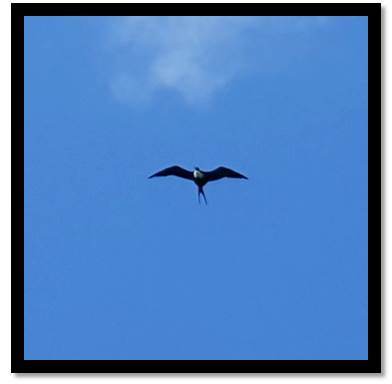
An adult female Great Frigatebird soars above Sand Island on Midway Atoll.

We generally admire predators, understanding that that they need to kill other animals in order to survive. After all, everyone’s got to eat and most of us humans sacrifice the lives of other creatures for our daily sustenance. And it’s certainly true that most animal species, including our own, sometimes find themselves in conflict with others of their kind, so when fights break out between individuals over territory or mates, we tend to shrug our shoulders and attribute such violence to Darwin’s theory. Albatross, for example, are generally peaceful creatures but at the start of the mating season, things can get pretty ugly.

What is it about the frigatebird then that illicits such negative reactions from people? Why do I often find the word “asshole” forming on my lips as I watch them fly by?

In terms of public image, frigatebirds face some real challenges. First, they are very large and kind of scary looking. Cloaked in black feathers and having a wingspan exceeding 2 m (80 inches) and a long hooked beak, they are imposing looking as they circle above Midway in vulture-like fashion. Unlike vultures, they are not scavengers, which becomes apparent when they suddenly burst into rapid flight chasing down a seabird as it returns from a foraging trip to sea and harasses it mercilessly until it drops whatever food it's carrying. Then, before the regurgitated fish or squid hits the water, the frigatebird swoops down and catches the morsel in mid-air. A pretty clever trick, really, and it sure beats having fly out into the open ocean to catch your own food. In biological jingo this is known as kleptoparasitism, a portmanteau of klepto (Greek for stealing) and parasitism (to harm without killing). The Hawaiian word for this species, in fact, is ‘Iwa, meaning thief.

Watching frigatebirds engage in their thieving ways must surely rank as one of the most amazing wildlife spectacles, and on Midway this behavior is very easy to observe, especially this time of year, when frigatebirds are nesting and must feed not only themselves but also their hungry chicks. My favorite place to watch frigatebirds is at the Cargo Pier where you can sit as the sun sets, drink a beer or three, and get a really good view of the action. Just look for a Red-Footed Booby or Red-Tailed Tropicbird heading towards land and there’s a decent chance you’ll get to see a chase. (Male frigatebirds pursue sooty terns and noddies as well, but for whatever reason this seems more difficult to observe.) For the victim there’s a lot at stake – losing the food they are carrying might diminish the bird's chance of successfully fledging a chick – so they don’t give in easily. The result is often a truly spectacular aerial chase in which the booby or tropicbird attempts every flying maneuver it has in its repertoire. The bird in pursuit flies as fast as it possibly can, then suddenly twists and turns to evade its pursuer. Unfortunately for boobies and tropicbirds, the frigatebird possesses exceptional flying skills, a consequence of its large wing area to body mass ratio as well as a very long forked tail which makes it incredibly agile for its size. Frigatebirds also often attack in small “gangs”, making it even less likely the bird being pursued will succedd in escaping.

Frigatebirds soar high among White Terns scanning the skies for their next “victim” from which to steal a meal

Reasons to despise the great frigatebird don’t end there. These birds have an unsavory habit of eating eggs or small chicks (especially terns and noddies) when a nest is left unguarded.  I’ve seen them flying with Sooty Tern chicks in their bills on Eastern Island. They apparently will engage in cannibalism too, stealing eggs or chicks from other frigate nests. Frigatebirds may also attack vulnerable fledglings when they are trying to learn to fly. I once watched two frigates torment a young Bonin Petrel that was floating in the water off West Beach; they dove at the petrel repeatedly for several minutes, sometimes grabbing the fledgling, flying up a few feet, and then tossing it violently. Eventually the frigates tired of the game and left the petrel there in the water, looking much the worse for wear (I’m guessing it died).

Frigatebirds thieving ways are not limited to stealing food. Both male and female Great Frigatebirds work together to construct their nests; the male gathering the nest material and bringing it to the female who does the bulk of the building. Sometimes though, a male will find it easier to steal nest material from other birds rather than collecting it himself. Red-footed boobies, which often nest in very close proximity to frigatebirds, are a common victim. The situation is even worse if you’re a Black Noddy though, as the frigatebird is known to steal their entire nest! Then there is the issue of the nest itself which, because the frigatebird chicks lack the ability to eject their feces away, becomes covered in shit and quite stinky as time goes on.

Great Frigatebirds prefer to nest in shrubs or trees. On Eastern Island at Midway Atoll they find suitable habitat atop tree heliotrope (Tournefortia argentea).

So is the frigatebird really an avian A-hole? When I the idea of writing a blog post about the Great Frigatebird was hatched in my mind (sorry!), I was pretty convinced that this was so. But as I was researching this species I discovered that the story was much more complicated.

Frigatebirds, it turns out, share some of the same admirable traits possessed by albatrosses. Parents are monogamous (at least during a given breeding season), engage in interesting, if not completely endearing, courtship behavior, which include various postures including the male’s display of its gular sac. Both male and female equitably share in the incubation, brooding, and feeding of their one and only chick. This is no small feat as it can take over six months to raise one. Great Frigatebirds might even hold the record for avian parental dedication. Unlike albatrosses and many other seabirds, whose care of their chick ends at the time of fledging, adult frigatebirds continue to feed their slow-growing offspring for up to a year after they leave the nest.

A male Great Frigatebird displays its gular sac in an attempt to attract a female

OK, maybe you’re saying "so sure they are good parents but what about the stealing bullshit?". Having grown up in a neighborhood with a lot of mobsters I know what you're saying. Some of them were good parents too when they weren't out stealing and killing!  Well it turns out that kleptoparasitism accounts for just a small part, by some accounts just 5%, of the Great Frigatebirds diet, meaning that they obtain the bulk of their food – squid and flying fish, primarily – by (anthropocentrically-speaking) honest means. 

Frigatebirds certainly should be admired for their incredible flying abilities. Here on Midway you can often see them hovering very high in the sky, like large black kites, riding the air currents and rarely flapping their wings. Like albatrosses, they engage in a flight technique known as dynamic soaring, a sophisticated means of using differences in air speed to fly quickly and efficiently; frigatebirds cruise nearly effortlessly at speeds of up to 50 km / hr (30 mph). The frigatebird’s aerial prowess has enabled them to colonize a large swatch of the tropical and subtropical Pacific Ocean, from the South China Sea, to the Great Barrier Reef, and to Mexico and Christmas Island in the South Pacific. Some populations are even migratory. Midway lies just about at the northern extent of their range. This hyper-adaptation to a flying lifestyle does not come without a cost. The Great Frigatebird’s small legs and feet create difficulties for them when trying to take off; they don’t land in the water because if they did they might get stuck there.

Living around frigatebirds is definitely a unique opportunity and I feel a little embarrassed at not having taken the effort to look beyond the stereotypes and appreciate their other behaviors until now, over a year since beginning my assignment here. It makes me wonder how much stereotypes and lack of information, limit my appreciation of other species (or even my fellow humans!). An important reminder, I think, to question your assumptions and spend more time questioning and learning and less time judging.


Additional reading for the exceptionally curious:


Gilardi, J. D. 1994. Great Frigatebird kleptoparasitism: sex-specific host choice and age-related proficiency. Condor 96:987-993.


Monday, June 19, 2017

One Good Tern Deserves a Noddy


An adult white tern on Midway Atoll 

Not long after arriving at Midway I had an un-nerving experience.  I was walking down the road when I suddenly realized that I was being followed. Not by a person but by several small, brilliantly white, birds with long blue bills. Their wings beat quickly as they flew just a foot or two over me making hoarse “wreck wreck wreck” sounds. They seemed to want to land on my head or my shoulder and so I extended my hand to see if one would light, but they didn’t seem interested in getting quite that intimate. This is typical behavior for manu-o-Kū – the white tern!

White (sometimes called “fairy”) terns are small seabirds found across a wide portion of the tropics including the Atlantic, Pacific, and Indian oceans.  They occur throughout the Northwestern Hawaiian Islands but if you are visiting the main Hawaiian Islands you will find them only on the south shore of Oahu where a small population persists around Honolulu. At one time, white terns probably also occurred on the other main islands (e.g., Kauai) before cats, rats, dogs and other predators wiped them out. Unlike many seabirds that nest on the ground, white terns like to nest up high in shrubs or trees. And they don’t actually build a nest, they simply find a place that they think will hold an egg securely (the female lays just one) and “nest” there. On Midway typical nesting sites for white terns include ironwood trees and shrubs like plumeria and tournefortia, especially where a branch forks creating a small depression. But they also nest on air conditioners, windowsills, garbage can lids, utility boxes, and other odd places. After a short fall hiatus, “tern season” begins in December with the first chicks born around March and peaking during the warm summer months of June, July and August.

The white tern holds a special place for the Hawaiian people which is reflected in its native name (manu means bird and is one of the four great Hawaiian gods). Moreover, the Hawaiian people have likely had a close relationship with this bird for hundreds if not thousands of years. Ancient Polynesian voyagers used white terns to navigate as they are one of the most reliable indicators of land. Compared to albatrosses and other far-ranging seabirds, white terns stick pretty close to home (within a hundred or so miles). Like a suburban commuter, terns leave their islands each morning to spend the day at sea foraging, returning each evening. If the navigator of a canoe wanted to find land, he’d look for white terns flying and, depending on the time of day, either head in the direction they seemed to be coming from (morning) or follow it back towards land (evening). Terns follow us and vice-versa. 

My experience with white terns at sea is mostly limited to swimming where I often find myself being followed by a small, raucous flock. What is it that makes the tern want to follow people whether on land or in the water?  I’m not sure anyone really knows. It could be that they are just very curious creatures. This would jibe with one of their other interesting behaviors which is to sit on a windowsill looking inside towards the occupants. Many a morning I have eaten breakfast under the dark black, watchful eyes of one or two white terns.

A pair of white terns investigating me from the windowsill of my house

I have also enjoyed watching white terns forage from my favorite relaxation spot out on the cargo pier. Terns fly low over the water looking for small fish near the surface and then swoop down quickly to capture them in their bills. When foraging to feed their chicks they have to gather several fish at a time and somehow they are able to do this – catching fish when they are already holding one or more crosswise in their bills.

Everything about this bird seems surreal. Its pure white plumage punctuated with blue beak, legs, and feet. It’s habit of fluttering around you like some spirit animal. Like most other native birds on Midway, white terns have virtually no natural predators and as a result do not seem to have much fear of people and, thus, can be approached at very close distance allowing you to really feel a part of their world. This extends to their sex life as well and it is common to see birds engaged in either foreplay or copulation, the former of which consists of intense, alternating, preening of one another. White terns are thought to pair for life, which can mean a very long time and courtship behaviors – which includes high altitude “couples flights” help maintain their pair bonds. And then there are the chicks. One day there’s an egg on your windowsill and the next you find a tiny white and brown ball of fluff with oversized, webbed, feet.  The parents share equally in both incubation and feeding. Parents fly out to sea and return with a beakful of a whole fish which seem impossibly large for the chick to swallow but the little fluff ball somehow always manages having what seems like insatiable hunger. As the chick grows, the size of the fish brought to it increases commensurately.

It takes about 48 days after hatching before a chick is ready to fly.  Clockwise from upper
 left: White tern egg on windowsill; a newly hatched chick; 2 week old chick; 1 month old chick.

During the summer it’s sometimes necessary to relocate a chicks and raise them in captivity. This happens when some project – for example, tree removal – eliminates the chick’s “nest site”.  As the chick's parent can no longer find it, the chick must be fed by hand. Each day volunteers make three trips to the “white tern nursery”, located just down the road from the office, where branches have been affixed to large ironwood trees to create safe places for the chicks. Volunteers then feed the chicks regular meals of Great Lakes smelt, by hand, three times a day until the chicks are big enough to feed on their own. This is, without doubt, one of the best jobs there is on Midway as when the chicks get big enough to fly they actually follow the lucky fish dispenser back and forth from the office begging for treats.

Fledgling white tern chicks swoop down to take smelt from the hand of
Fish and Wildlife Service volunteer Aisha Rickli-Rahman

It seems that nearly everything about the white-tern lends itself to superlatives; and even the scientific name of the species – Gygis alba – reveals the sublime effect this bird seems to have on the imaginations of those lucky enough to spend time around them:  the genus, Gygis, is a variation of the ancient Greek word “guges” which means “mythical bird”.

So maybe at this point you’re wondering where the “noddy” ties into this story or, maybe, you’re even cynically thinking that in the title of this post I have crassly sacrificed good natural history for the love of bad puns. Fear not! Another name for the white tern is “white noddy”, noddies being a collection of taxonomically-disparate, fork-tailed seabirds in the family Laridae.  White terns are not the only noddies on Midway as we are “blessed” with both brown noddies and black noddies not to mention several species of terns – sooty tern, gray-backed tern, little tern, and least tern. Clearly, I don’t have time to do justice to all of these species here but maybe I can at least provide a proper introduction.

Black and brown noddies, as the name would suggest are most similar to white terns in terms of habitat and behavior. Both are common at Midway and, if they were easier to tell apart, I might be able to tell you more about how they differ. My understanding is that the black is less common as it is an obligate-tree nester while the brown noddy can nest in either tree or on the ground. Brown and black noddies are more likely to form small flocks than is the white tern and gangs of them can often be seen on the beach this time of year. These birds seem to share the predilection of white terns for following swimmers and they also often accompany me on swims.

A brown noddy perches on an old ironwood stump on Eastern Island (Midway Atoll)

Let me also tell you about the sooty tern!  These easily-riled birds are not common on Sand Island but are found in astonishing abundance on the other two islands of the atoll where people are scarce. Sooty terns are gregarious ground nesters that form large colonies on Eastern and Spit Islands. During their nesting season – which lasts from April until October – they blanket areas of the atoll and must be avoided at all cost. Should you fail to be pay proper attention and happen to walk too close to one of their colonies you will trigger them to take off, creating a swarm of thousands of screaming birds. You may be temporarily deafened and notice that one of them is now swooping down and try to take a piece of flesh from your face! You may then also suddenly find yourself walking among their well-camoflaged eggs and  praying that you don’t accidentally step on one. Gray-backed (or spectacled) terns are rarer than the Sooty tern, but no less easily agitated and tend to nest around the edges of the sooty tern colonies. They must also be treated with extreme caution.


As for the final two terns on our list, the little and the least (seriously, who comes up with these names), they are both pretty rare and exciting to see.  Being the mediocre birder that I am, I have little to report but a few random sightings that I probably would not have even noticed were it not for the astute observations of others. But they are here and the breaking news is that the least terns are currently nesting!

If you are a regular reader of this blog you may have thought, until now, that Midway was all albatrosses and petrels.  I hope that this short detour into the lives of other important and interesting seabirds that inhabit the atoll gives you a more complete appreciation of the bird life here. And there is more!  You can look forward to a couple more bird-related blog posts in the future.


Sunday, May 21, 2017

The Moaning Birds


With less than six months to go here, I am feeling some urgency and want to be sure I have the chance to share with you more observations of the incredible wildlife of Midway Atoll. I've written quite a bit about albatross, touching on their fascinating courtship and breeding and also the precarious early lives of the chicks and their coming of age spectacle. In other posts I've written more broadly about the birds of Midway, the behavioral consequences of isolation and touched on some of the amazing marinecreatures whose lives reach onto the edges of the atoll.  But there is so much more!  So beginning with this post, my plan is to write a series of short pieces on Midway's wildlife so you can better appreciate the unique nature of this place.

While albatrosses and, in some locales, terns dominate during the daylight hours on Midway, once the sun sets, it is the petrels and shearwaters that rule.  Bonin Petrel and Wedge-Tailed Shearwater are nocturnal, burrow-nesting seabirds that have, since time immemorial, made their home on remote, uninhabited, oceanic islands where their nests are safe from rats, cats, dogs, snakes, and other predators. Like albatrosses, petrels and shearwaters are long-lived seabirds that spend most of their time in the open ocean returning to land only to breed. It is only there that I, a terrestrial organism, have the opportunity to observe them and so whatever information I am able to glean during these interactions is woefully incomplete. Their lifestyles also make them difficult subjects for scientific study so even today there is much that is simply not known about them.

"Bonin Petrel Season" begins in August when the birds make their way back to Midway from their maritime home in the Central Pacific Ocean to begin their long breeding season. Their frenzied courtship season lasts for nearly six months during which birds also attempt to establish a territory around their burrows. During this time, petrels – numbering in the hundreds of thousands - fill the sky every evening just as the sun begins to set. They fly high and low, circling, swirling in a way that reminds me of the huge "clouds" of Mexican free-tailed bats I used to watch during my summer at Carlsbad Caverns in New Mexico. Here on Midway, one of the only places in the world you can observe this, the phenomenon is known locally as a "birdnado" (bird X tornado).

At dusk each day in the fall and winter the skies on Midway
fill with thousands and thousands of Bonin Petrels.
Powerful and agile fliers, the petrels occasionally engage in high-speed chases. They seem pretty good at avoiding crashing into one another but not so much when it comes to "foreign moving objects" such as a human being out walking or, worse, riding a bike. This is both annoying and dangerous (for both human and petrel). Imagine getting hit in the face by a robin-sized bird flying at great speed as you pedal your way through the pitch black darkness on a pot-holed road! You can increase your chances of petrel-impact by wearing a headlamp. Often I've had to make the difficult choice of trying to navigate in nearly complete darkness without a light against the risk of getting "cold-cocked" by a petrel. 


After the sun goes down the petrels continue to fly, enabled by what must be excellent night vision.  Unlike bats, whose flights are mostly quiet, the Bonin petrel punctuates its flight with rather disturbing moaning, growling and screeching sounds. "Kukuer", "tititi" or "kikikiki", "kikooer", and "churr" are just a few of the ways these calls have been described though I'm not sure these really convey how un-melodic they sound. Better you listen to the sounds yourself by clicking on this link.

A pair of Bonin Petrels court near their burrow

As the night progresses, birds make their way to the ground covering the "lawns" and obstructing roads and walkways.  Birds may be solitary or be seen in pairs engaged in their various and courtship behaviors which include moaning, biting, preening and chasing. In addition to the birds, you may notice sand flying out of a hole in the ground. Petrels dig their burrows by picking at the soil with their bills and then kicking backward out of the burrow with their feet. Petrels are pretty open-minded about what is "habitat" and do not limit themselves strictly to the outdoors. I often encounter petrels in the garage at the office where the space between the chest freezer and the wall seems to be a popular "dating spot".  When I arrived last year, there was a freshly hatched petrel chick hidden behind a garbage can.


By morning the petrels have disappeared. Where did they go?  Some birds are probably out at sea while others remain in their burrows.  But even though the birds themselves aren't apparent, their numerous burrows, which seem like they might have been made by tiny badgers, make them impossible to ignore. Anywhere the sand is deep enough to allow it, a petrel has likely constructed its burrow and a large portion of Sand Island is perforated by them. Unlike a badger's burrow which you can typically walk over without collapsing it, petrel burrows are shallower and the sand and coral substrate makes them very unstable. Walking in an area with petrel burrows – that is, walking pretty much anywhere off an established road or trail – brings with it the high risk of falling into one. Like human-petrel collisions, this is also bad for both parties. People twist ankles and knees; eggs are crushed and birds become entrapped. Proper protocol after stepping into a burrow is to get down on your hands and knees to free any birds that were buried and to reconstruct the nest as best as possible. Walking across areas with petrel burrows is a learned-skill and someone who doesn't learn it well may be called, derisively, a "burrow crasher" (though not usually to the person's face). Obviously, a person's weight probably plays a role in whether or not they tend to fall into burrows so I wonder if this might too be a backhanded way of making fun of those, like me, that aren't exactly slender.

Once the nest is established and the single egg is laid things calm down a bit and the daily birdnado seems somewhat diminished. Like albatross, both male and female share in the incubation of the egg as well as the feeding of the chick. Nesting in a burrow apparently makes a lot of sense on a subtropical island as underground temperatures are cooler during the daytime and relatively warm at night. Predation of eggs and chicks by frigate birds and other aerial predators is also greatly reduced. Bonin Petrel chicks, round balls of gray and white fluff, begin hatching in March and they just might be the cutest thing you've ever seen. As they get bigger they learn to beg and one evening I was treated to the sight of a chick that had come outside its burrow being fed by its parent.  Like albatrosses, petrel parent feed their chicks by regurgitating stomach oil into the chick's bill.

A young Bonin Petrel chick

In late May petrel chicks begin to fledge though I will admit I'm not sure I've ever actually witnessed this as the fledglings look very similar to adults. After fledging, there is a brief period of time when Bonin Petrels are absent from Midway which provides a short window of opportunity for people on the atoll to get any projects done that require excavation or the movement of any heavy equipment off roads. Late summer and early fall is thus a very busy time for contractors here.

Though much less abundant than the Bonin Petrel, Wedge-tailed Shearwaters are hard to ignore during the times of year they are present here at Midway. The shearwaters don't seem to spend much time flying around over the island and, in fact, I hardly ever see them and have never seen one of their underground nests or a chick. Although I've read that they have a "musky odor", I will also admit to never having had the chance to verify this with my own nose.  So what could I possibly even write about?

The breeding season of Wedge-tailed shearwaters is distinct from that of the albatrosses and petrels beginning with first egg-laying in June and culminating in the fledging of chicks in November.  I wonder if this has something to do with the geographic range of the species which encompasses broad swaths of the Pacific and Indian Oceans both south and north of the equator (from Mexico to Japan and from New Zealand to South Africa!). As you might expect, breeding begins with courtship which takes place near the pair's burrow entrance and includes what might be the creepiest moaning sounds uttered by any bird. The sound, produced using their throat as well as a "gular pouch", is composed in two parts, a "OOO" made while inhaling and an "err" that is exhaled. You must hear it to truly appreciate it which you can do by clicking here.

A pair of Wedge-tailed Shearwaters

During this time of year, the sound of Wedge-tailed Shearwaters are heard nearly every evening. As these birds are not as numerous as petrels, the moaning is not ubiquitous, but rather emits from specific locations, often from within a stand of naupaka shrubs or ironwood trees. The localized, hidden sources of the sounds combined with the near pitch black darkness of the atoll, add to the eerie quality of the chorus. Here's how FC Hadden, a resident of Midway in the 1930s, described it:

Any person taking a walk around Midway in the evening when it begins to get dark, during March or April, is apt to have a most hair-raising experience. Suddenly out of the dark will rise the most blood-curdling howls, yowls, moans, and groans. Not only that, but it sounds as if there must be a dozen tomcats tearing each other to pieces, from the wild cat-like shrieks that penetrate the ear, then some woman begins to groan and gasp and moan, as though about to die in the greatest of pair. All of these various ghoulish noises are so heart rending, so horrible, that one must indeed be brace to investigate them. What a horrible experience it must have been for those first sailors who were shipwrecked here many years ago. Certainly they huddled around their fire trembling and shaking when they first heard these wild cries. 
Early residents of Midway referred to the Bonin Petrel as the "small moaning bird" and the Wedge-tailed Shearwater as the "large moaning bird".  Unlike the albatrosses, whose daytime habits, humorous antics and outgoing personalities endeared them to people, the "moaning birds" were mostly scorned. Being creatures of the night, one can only imagine that some thought of them as evil. This was after all one hundred years ago when people were less scientifically-minded and more superstitious (although these days I often wonder how far we've actually come). The burrows that they made were also an inconvenience, not just because they made walking difficult but they also reduced harvests from the gardens that were established to provide food for the island's residents (today, there is an enclosed greenhouse). During the Navy years the petrels and shearwaters continued to be treated badly.  Ornithologists Harvey Fisher and Paul Baldwin visited Midway in 1945 to investigate conditions for the various birds there and reported

The "moaning birds," of which the Wedge-tailed Shearwater was the most dismal-voiced, were generally disliked by the men. They received little sympathy, burrows were purposely tramped down and adults were persecuted constantly. This was the only openly discussed form of deliberate destruction of birds we found, as irresponsible target shooting was done more or less on the sly and was not generally approved. Bonin Island Petrels were in areas desired for lawns and consequently were destroyed. Bulldozing in certain areas must have killed thousands of shearwaters and petrels in their burrows.

Although data are scant, the numbers of petrels and shearwaters are thought to have declined precipitously on Midway throughout the years when the Navy maintained its air station. In addition to direct persecution and destruction of habitat rats,which were transported to Midway by ship sometime in the early 1940s, also took a heavy toll. By the time that the US Fish and Wildlife Service took over management of the atoll in 1996, populations of these birds were at just a fraction of their original numbers.

Today, Bonin Petrel populations appear to have rebounded to approximately their original numbers – the best guess is somewhere around 1 million birds, although large areas of the atoll, especially Eastern Island are still covered in pavement and thus inaccessible to them. As this is a species with a relatively small geographic range, this recovery holds real significance for the global population (its other strongholds are volcanic islands off the coast of Japan). For reasons that are not clear, Wedge-tailed shearwaters have been slower to recover, perhaps a consequence of their more restrictive habitat requirements. Habitat restoration efforts aimed at increasing the amount of sand dune and naupaka shrub habitat may aid in their recovery.

Nocturnal, burrow-nesting birds are in need of good PR. Special events
can help educate the public as to the great value of these birds.

 As an agency committed to the conservation of birds and other wildlife, the US Fish and Wildlife Service has taken exceptional measures on Midway to ensure that petrels and shearwaters will continue to thrive at Midway Atoll. One thing that hasn't changed though is the difficulty that people seem to have in liking these birds. Some seeking to change public opinion have created small informational placards that sit next to the salt and pepper on the tables of the Clipper House. Others have gone as far as putting on special events in their honor, for example, the Bonin Petrel Appreciation Night that was hosted last January by visiting seabird biologist Roberta Swift. Maybe the PR is working. After a year, I can honestly say that after some hesitation I have become a genuine fan of the "moaning birds" and look forward to proudly displaying a portrait of a Bonin Petrel on the wall of my living room back in Oregon when my time here is through.


References


Fisher, H. I. and P. H. Baldwin. 1946. War and the birds of Midway Atoll. The Condor 48:3-15.

Hadden, F. 1941. Midway Islands. The Hawaiian Planters Record 45:179-221.